516-681-5330Request a visit

Procedures

Bone Grafting & Sinus Augmentation

Reconstruction of bone lost to extraction, periodontal disease or trauma, including socket preservation, ridge augmentation and sinus lifts.

Anesthesia
Local or IV sedation
Graft maturation
Typically 4 to 9 months
Graft sources
Your own bone or banked material
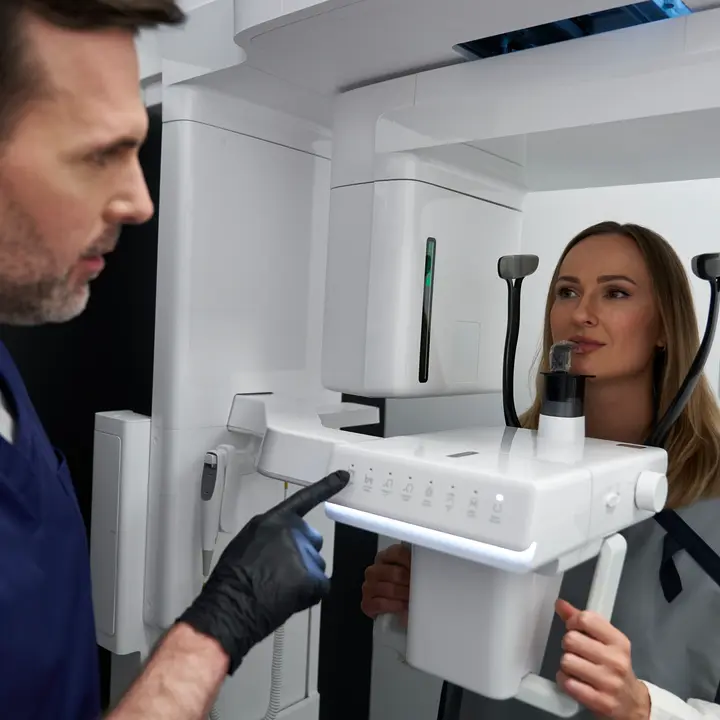
A clinician positioning a patient in a cone-beam CT scanner

Overview

What the procedure involves.

After a tooth is lost, the alveolar bone that supported it begins to resorb, losing width first and then height. In the upper back jaw the maxillary sinus also expands downward into the space. Years later, there may not be enough bone to hold an implant.

Bone grafting rebuilds that volume. A graft acts as a scaffold that the patient’s own bone grows into and gradually replaces, restoring a ridge that can support implants and a natural-looking restoration.

Conditions we treat

  • Bone loss after extraction or long-standing tooth loss
  • Narrow ridges unable to hold a standard implant
  • Pneumatized maxillary sinus over the upper back teeth
  • Defects from periodontal disease, infection or trauma
  • Bone loss around failing implants
  • Defects left after cyst or tumor removal

Techniques & treatment options

Matched to the diagnosis, not a template.

  1. Socket preservation

    Graft material is placed into the socket at the time of extraction to limit the collapse of the ridge that otherwise follows.

  2. Guided bone regeneration

    Particulate graft is protected by a barrier membrane, which keeps soft tissue out while new bone forms beneath it.

  3. Lateral window sinus lift

    A small window in the side of the maxilla allows the sinus membrane to be elevated and graft placed beneath it, for larger gains in height.

  4. Crestal (osteotome) sinus lift

    Through the implant site itself, the sinus floor is gently raised a few millimeters, often with the implant placed at the same visit.

  5. Ridge expansion

    A narrow ridge is split and widened, and the space filled with graft, so an implant of proper diameter can be placed.

  6. Block grafting

    For larger defects, a block of bone, often harvested from the chin or the back of the lower jaw, is fixed in place with small screws.

Graft materials

Autogenous bone, taken from the patient’s own jaw, contains living cells and remains the reference standard. Allografts (processed human bone from a tissue bank), xenografts (mineral from bovine bone) and synthetic materials avoid a second surgical site and are well documented. The choice depends on the size and shape of the defect and the timeline for implant placement.

Planning with three-dimensional imaging

Cone-beam CT shows the volume of bone in all three planes, the thickness of the sinus floor and the health of the sinus membrane. It determines whether the implant can be placed with the graft or must wait for the graft to mature.

Recovery

What to expect afterward.

Most patients rest for a day and keep activity light for a week. After a sinus lift, nose blowing, straws and air travel are avoided while the membrane heals. The graft is evaluated radiographically before the implant stage.

After Dental Implant Surgery

Questions

Bone Grafting: common questions.

Does every implant need a bone graft?

No. Many sites have enough bone. Grafting is planned when imaging shows the ridge is too narrow or short, or when the sinus has expanded into the implant site.

Is the graft rejected?

Banked and synthetic graft materials are processed to be biocompatible and do not trigger rejection in the way an organ transplant can. Infection and graft exposure are the main risks, and both are uncommon.

Can the implant be placed at the same visit?

Often, yes. With a crestal sinus lift or a small augmentation, the implant can usually be placed at the same time. Larger reconstructions are staged so the graft can mature first.

Plainview, Long Island

Ready when you are.

Request a consultation online, or call the office. We will find a time that works and answer your questions before you come in.